How to Automate KYC for Australian Payment Providers 2026
How to Automate KYC for Australian Payment Providers in 2026
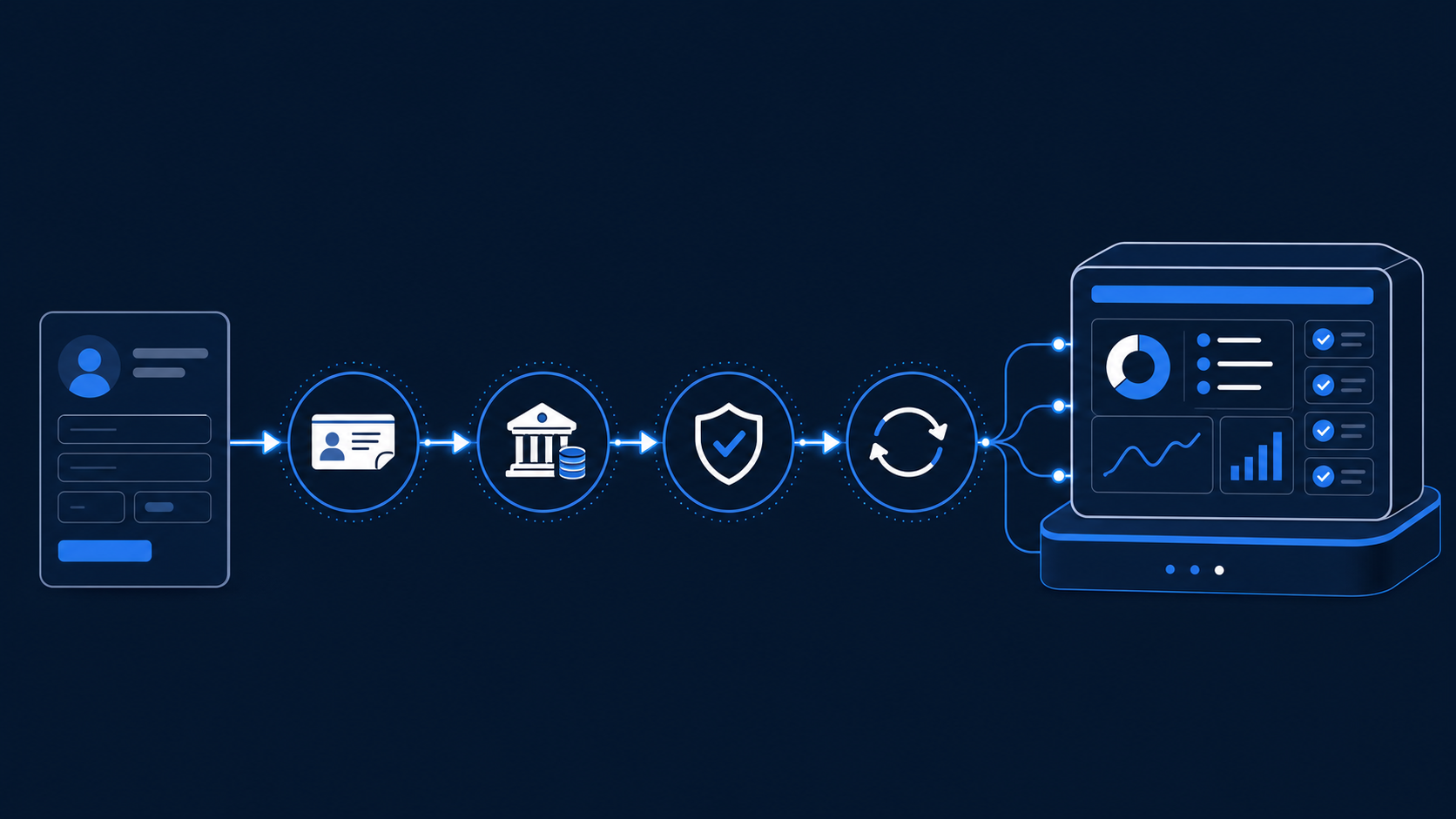
Automating KYC for a payments business means turning identity verification, business checks, sanctions screening and ongoing monitoring into a single, rules-driven workflow that runs in seconds instead of days, without handing your compliance team more manual review than they can clear. In 2026, that isn't an efficiency project. It's how you stay compliant and keep onboarding customers at the same time.
Here's why the timing matters. Payment and remittance providers are existing reporting entities under the AML/CTF Act, and the reformed Rules that commenced on 31 March 2026 raised the bar on customer due diligence, ongoing monitoring and sanctions screening (AUSTRAC). At payments volume, that's not something a team can do by hand, as Pinch Payments found when manual checks capped it at five merchants a day. This guide walks through how to automate KYC from onboarding to ongoing monitoring: what to verify, how to orchestrate it, and where automation earns its keep.
What “automating KYC” actually covers for payments
KYC is the narrow term people reach for, but a payments provider is really automating four connected jobs:
- KYC: verifying individual customers through identity documents, data checks and, where the risk warrants it, biometrics and liveness.
- KYB: verifying the businesses and merchants you onboard, plus their beneficial owners.
- AML screening: checking customers, beneficial owners, beneficiaries and agents against sanctions, PEP and adverse media lists in real time.
- Ongoing monitoring: watching for changes across the customer lifecycle, not just at signup.
Automation connects those four into one decision, so a customer or merchant is verified, screened and risk-rated before anyone opens a case.
What the 2026 reforms require your automation to do
You can't design the workflow without knowing what it has to satisfy. A few things changed on 31 March 2026 that shape every automation decision:
- Ongoing customer due diligence applies to all customers from 31 March 2026. Unlike initial CDD, which has a three-year transition window, ongoing CDD has no transition at all. Verification stopped being a one-off event on day one of the reforms.
- Sanctions screening is a stated policy requirement: your program must ensure designated services don't contravene targeted financial sanctions, screening customers, beneficial owners, beneficiaries and agents.
- The old Part A and Part B program split is gone, replaced by a single outcomes-focused, risk-based program (AUSTRAC).
- Value transfer obligations changed, with a new IVTS report set to replace the current IFTI report over time under transitional rules (Home Affairs). If you move money across borders, your monitoring and reporting have to keep up.
One clarification, because vendors get it wrong: the 1 July 2026 date covers newly regulated Tranche 2 professions like lawyers and accountants. As a payment provider, you were already regulated and worked to 31 March 2026.
How to automate KYC, step by step
1. Map your flows and risk before you automate anything
Automation amplifies whatever logic you feed it, so start with the map, not the tooling. Separate the journeys: individual customers need KYC, while merchants and businesses need KYB and beneficial ownership checks. Define what “higher risk” means for your book (cross-border, high value, certain merchant categories, PEPs), because that's what triggers enhanced due diligence. Write the risk rules down first. The platform's job is to execute them, not invent them.
2. Orchestrate your data sources instead of integrating them one by one
The slowest, most expensive way to automate KYC is to integrate each data provider yourself: one vendor for local identity, another for global, another for sanctions, another for business registries, each with its own contract, integration and failover. Orchestration flips that. You connect once to a layer that routes each check to the right source, falls back to a second source when the first can't verify, and lets you switch or add providers without re-integrating. For a payments business operating across borders, that's the difference between launching in a new market in weeks rather than quarters.
3. Automate identity and business verification
For individuals, automate document capture and data checks against authoritative sources, and add biometric or liveness checks only where the risk warrants them. Resist the urge to put every consumer through a full biometric flow. At payments volume, friction you don't need is conversion you don't keep.
Merchants are where verification gets genuinely hard, and where most payments providers underinvest. Automate business verification and beneficial ownership resolution so you're not emailing a merchant for their company extract and a director's ID three days into onboarding. The bar is straight-through processing for the clean majority, with human review only for the cases that have actually earned it.
4. Screen in real time, and keep screening
Screen every customer, beneficial owner, beneficiary and agent against sanctions, PEP and adverse media lists at onboarding, then keep screening on a schedule and on trigger events. For a payments business the reforms make one point unmissable: it isn't just your customer. In a value transfer you're expected to screen the parties on both sides, so screening that stops at the account holder leaves the obligation half-met.
And be honest about what “ongoing” means. An overnight batch run isn't ongoing monitoring, it's a slower version of the old point-in-time check. Real-time screening at onboarding protects the signup. Continuous re-screening against list changes is what actually meets the perpetual-monitoring standard.
5. Risk-rate and decide automatically
Feed verification and screening results into a customer risk rating, and let the workflow decide: approve, step up and request more, or refer to review. A good rule set clears the clean majority automatically and reserves human attention for the cases that actually need judgement. This is where automation either wins back your team's time or, done badly, buries them in false positives.
6. Monitor continuously, not just at signup
Ongoing CDD is now the standard, so build monitoring in from day one. Watch for watchlist changes, behavioural shifts and profile changes across the lifecycle, and route material changes back into the same review queue. Treating onboarding as the finish line is the single most common way payments providers fall short of the 2026 rules.
7. Keep the audit trail and reporting ready
Every automated decision has to be explainable and reproducible after the fact. When AUSTRAC or your own board asks why a customer was cleared or a merchant declined, “the model decided” is not an answer. Log what was checked, which source returned what, and the rule that drove the outcome, so any decision can be reconstructed months later.
Reporting is the part payments providers most often hardcode and later regret. As value transfer reporting shifts from IFTI to IVTS under the transitional rules, the obligation sits with the reporting entity closest to the Australian customer, and your pipeline has to bend to that without a rebuild. Treat reporting as configurable from the start, not a fixed integration you'll be unpicking in 2029.
8. Tune for false positives and conversion
Automation isn't set-and-forget. Track your pass rates, false-positive rates and manual-review volumes, and tune thresholds so you're not rejecting good customers or drowning your team. The goal is high straight-through pass rates with fraud and true hits still caught, not a system so cautious it kills conversion.
How to tell your automation is working
Automating KYC isn't a one-time switch, so judge it on numbers, not on the fact that it's live. Five are worth watching from day one.
- Straight-through pass rate: the share of customers and merchants verified without human touch. Higher is better, but only if fraud and true hits are still being caught.
- False-positive rate: how often the system flags a clean customer. This is the number that decides whether your team is doing compliance or just clearing noise.
- Time to decision: how long a customer waits to be approved. In payments this maps almost directly to conversion.
- Manual-review volume: the cases routed to a person. If it's climbing, your rules or thresholds need tuning, not more headcount.
- Re-screening coverage: the proportion of your book monitored on an ongoing basis. Under the 2026 rules this should be all of it, not just new signups.
Read them as a set. A high pass rate with climbing false positives means you've tuned for speed at your team's expense.
Common mistakes payment providers make
- Automating onboarding but not ongoing monitoring. It's the fastest way to look compliant on day one and fail a review later, because the reforms treat monitoring as continuous.
- Buying an Australia-only tool, then finding it can't verify or monitor a cross-border transaction. For a business that moves money offshore, that gap surfaces the first time a customer pays a counterparty in another market.
- Stitching together point vendors. Each integration is another contract, another failover to build and another thing to re-certify at audit, and the maintenance cost usually outgrows the check itself.
- Tuning too tight or too loose. Over-tuned rules bury the team in false positives and reject good customers; under-tuned rules let fraud through. Both are expensive, in different currencies.
- Treating KYB as an afterthought. Merchants are often half your risk, and beneficial-ownership checks are where onboarding quietly stalls when they're done by hand.
How FrankieOne automates KYC for payments
Full disclosure: FrankieOne is our platform, so here's how it maps to the eight steps above, and what it's changed for two payments businesses running this exact playbook.
FrankieOne is a unified platform for global identity, fraud and compliance orchestration, connecting to 350+ best-in-class KYC, KYB, AML and fraud providers through a single integration, across 190+ countries. We serve 250+ customers across financial services, including Westpac, Pinch Payments, and pay.com.au. In practice, the eight steps above run through one integration rather than a stack you assemble yourself, with configurable workflows that execute your risk rules and route only genuine edge cases to review. Because the platform is vendor-agnostic, you can switch or add data sources as you enter new markets without re-integrating, and banks and fintechs on it can see on average 15%+ uplift in pass rates and a 53% reduction in fraud losses.
Pinch Payments: from manual ASIC lookups to 300% more onboarding capacity
Pinch Payments (now part of Fiserv) serves over 2,000 merchants across Australia and New Zealand. Before FrankieOne, it ran merchant onboarding entirely by hand: documents chased one merchant at a time, ASIC reports pulled separately, everything cross-referenced line by line, roughly 30 minutes a check, with a ceiling of about five merchants a day. Embedding FrankieOne's KYC, KYB, AML and sanctions screening and beneficial ownership reporting directly into its Glassbox platform changed the maths. Within three months, Pinch lifted daily merchant onboarding capacity by 300%, cut KYC turnaround from four days to under 24 hours, and reduced individual compliance reviews from 30 minutes to under 5. Risk and Compliance Manager Felix Tan credited a partnership with the “genuine willingness to collaborate and build something tailored to our business.” And the single integration that powers compliance in Australia switches on for New Zealand without rebuilding a thing.
pay.com.au: 25% higher pass rates, 40% fewer reviews
pay.com.au, the Australian B2B payments and rewards platform, replaced a fragmented stack of point solutions with FrankieOne across KYC, KYB, biometrics and AML screening. The numbers moved in the direction a payments compliance team cares about, all at once: a 25% uplift in first-pass verification rates, around 40% fewer manual reviews, and standard onboarding cut from 2-3 days to under 24 hours, all absorbed without adding compliance headcount. That's the measurement section in practice: pass rate up while manual-review volume falls, the exact combination step 8 is chasing rather than trading one for the other.
As Yvonne Gilmour, Head of Operations, Support and CX at pay.com.au, put it, they wanted a platform that could “scale globally with us, not just solve for Australian compliance.” That's the orchestration point again: local compliance as the starting line, not the finish.
Automate KYC without assembling the stack yourself
If you want to see how these eight steps run through one integration against your own onboarding and monitoring flows, we'll walk you through it. Talk to our team.
Related reading: KYB for payment providers, transaction monitoring, AML screening.
Frequently asked questions
Do payment providers have to automate KYC?
There's no rule that says you must automate, but the combination of high onboarding volume and the ongoing customer due diligence standard introduced on 31 March 2026 makes fully manual KYC impractical for most payment providers.
What's the difference between KYC and KYB for payments?
KYC verifies individual customers. KYB verifies businesses and their beneficial owners. Payment providers that onboard merchants need both, and automating only one leaves half the risk unchecked.
When did the 2026 AML/CTF reforms start for payment providers?
31 March 2026. Payment and remittance providers are existing reporting entities, so they worked to that date. The 1 July 2026 date applies to newly regulated Tranche 2 professions such as lawyers, accountants and real estate agents.
Does automated KYC satisfy AUSTRAC's ongoing monitoring requirement?
Only if you automate ongoing monitoring, not just onboarding. A risk-based program requires continuous customer due diligence, so verification at signup alone does not meet the standard.
How long does automated KYC take?
For straightforward cases, automated verification and screening can complete in seconds, with only edge cases routed to manual review.


.png)