On 1 July 2026, approximately 70,000 additional Australian businesses become reporting entities under the AML/CTF Act for the first time, bringing the total regulated population to around 90,000. Accountants, lawyers, conveyancers, and real estate agents are all in scope. Most of them have never had to think about AML compliance before. The UK went through the same shift years ago. Australia is catching up, and professional services firms have months, not years, to get there.
The Tax Practitioners Board added to the pressure by introducing its own KYC requirements ahead of Tranche 2, placing identity verification obligations on registered tax practitioners that are already in effect today. For most accounting practices, both sets of obligations pointed to the same gap: identity verification was never built into their workflows. Checks happened outside their software, through separate tools or manual processes, with no audit trail and no unified view of verification status.
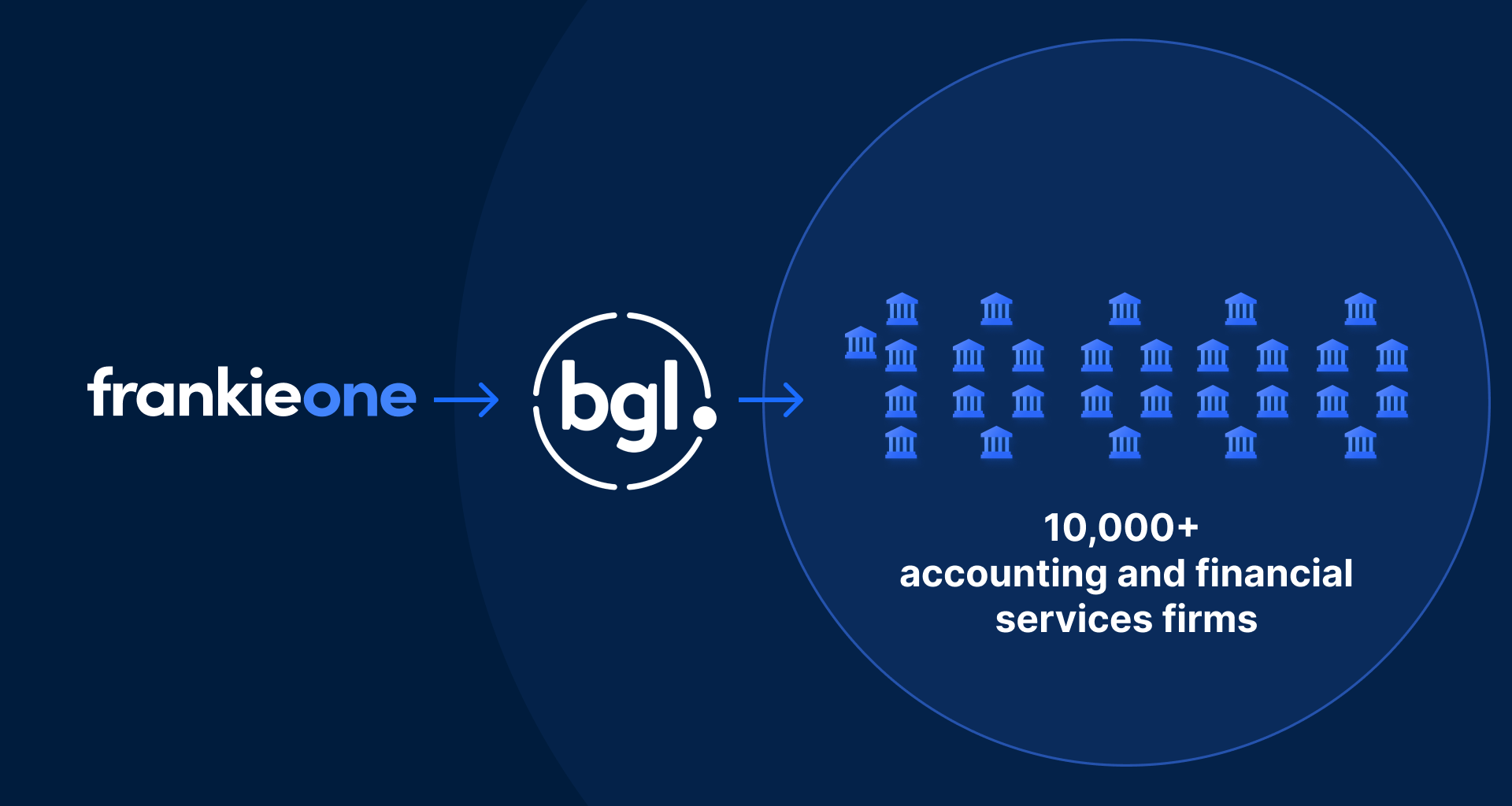
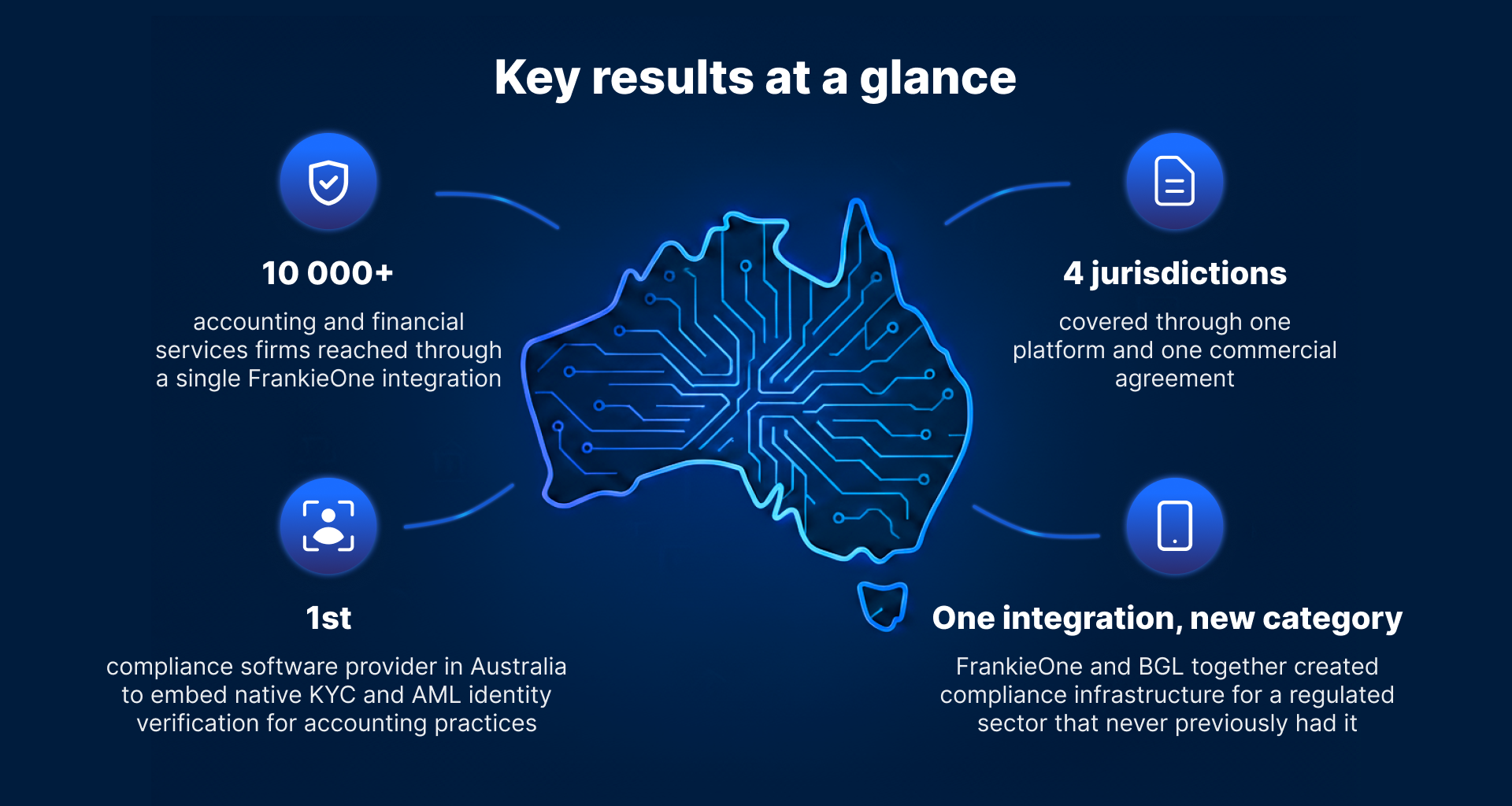
BGL Corporate Solutions decided to fix that. The result was BGLiD: the first native AML identity verification and document verification solution embedded directly into accounting compliance software. FrankieOne integrates once with BGL, and that single integration reaches 10,000+ accounting and financial services firms across four countries. One integration, a new compliance category, and an entirely new regulated sector with the infrastructure it needs.
Opening a new compliance category
Until recently, identity verification and AML compliance belonged to a specific world: banks, fintechs, lenders, and crypto platforms. The obligation, the tooling, and the expertise all sat within financial services.
Tranche 2 changes that. Under the expanded AML/CTF framework, accountants, lawyers, conveyancers, and other professional services firms become reporting entities under AUSTRAC for the first time. Many of these firms have sophisticated software managing their core workflows, but none of it was built with compliance obligations in mind.
BGL serves over 10,000 accounting and financial services firms through its flagship products CAS 360 and Simple Fund 360 across Australia, the UK, New Zealand, and Singapore. When Tranche 2 came into scope, those firms needed KYC and beneficial ownership verification embedded in the tools they already used, not bolted on beside them.
The challenge was not just regulatory. It was architectural. Building this capability from scratch, across four jurisdictions, at a pace the TPB (Tax Practitioners Board) obligations demanded, was not something BGL could do alone. It required a specialist partner with the platform to make it work.
The compliance gap at the core of accounting software
Before BGLiD, there was no KYC capability inside BGL's platform. Practices had to leave their BGL workflow, run checks in separate systems, and manually reconcile results. No centralised verification status. No audit trail. No scalable process.
That gap became urgent when two sets of obligations arrived at once. TPB KYC requirements were already in effect. Tranche 2 AML/CTF compliance was coming fast. And BGL's clients needed both addressed within the tools they used every day.
Building the capability internally was not viable. Multi-jurisdictional KYC rules, the pace of regulatory change, and the need to go live quickly all pointed to the same conclusion: BGL needed a partner who had already solved this problem.
Why a platform approach was the only viable option
When BGL evaluated its options, point solutions fell short. The challenge was not just verifying identities in one market. BGL operates across four jurisdictions, each with its own regulatory framework. A single-country solution would have solved the immediate Australian problem while creating a fragmentation issue everywhere else.
FrankieOne's platform covered all four markets through one integration. KYC, KYB, document verification, beneficial ownership verification, and ongoing monitoring, all orchestrated through a single API. One commercial agreement, no patchwork of vendors to manage.
Two regulatory frameworks shaped BGL's requirements specifically. FrankieOne understood both the TPB's KYC obligations already in force and the AML/CTF Tranche 2 requirements coming in July 2026, and built configurable workflows that could address each.
Government-grade document verification was also non-negotiable. FrankieOne's integration with the Document Verification Service connects directly to Australian government databases, covering passports, driver licences, Medicare cards, and international passports registered with the Australian government. That level of AML verification integrity is what TPB and AUSTRAC compliance actually requires - not document scanning or third-party data sources alone.
BGL's technical team wanted deep product integration, not a separate portal. FrankieOne's API-first architecture made it possible to build identity verification directly into CAS 360, Simple Fund 360, and Simple Invest 360 as a native capability.
One integration, 10,000 firms
Because BGL had no legacy system to migrate, the project started clean. That removed a layer of complexity and let both teams focus on building the right architecture from the start.
FrankieOne's integration team treated the deployment as a true product build. Verification workflows were configured and tested iteratively, aligned to BGL's release schedule. The outcome was BGLiD: a purpose-built identity verification product that accounting practices access without leaving their BGL platform. Since launch, the fail rate has improved from 15.7% to 12.4%, with quality improving as volume scales, not the other way around.
This is the one-to-many model in practice. FrankieOne integrated once. BGL built BGLiD on that foundation. And 10,000+ firms across four countries now have access to AML-grade identity verification without a separate integration, a separate vendor, or a separate workflow.
It is the same principle behind FrankieOne's partnership with PEXA, where a single integration into Australia's dominant property settlement platform creates compliance infrastructure for an entire sector. The pattern is consistent: connect to the platform that already sits at the centre of an industry's workflow, and compliance capability flows to everyone on it.
For the first time, practices could see verification outcomes, pass rates, exception handling, and audit trails directly within their BGL workflow. From no data at all to a complete picture of their compliance position. They went from blind to informed very quickly.
"FrankieOne gave us a simple, flexible platform to orchestrate complex KYC and KYB checks at scale, allowing us to reduce operational friction and lead the market in compliance."
Jeevan Tokhi, Chief Product Officer, BGL Corporate Solutions
What this means for the July 2026 Tranche 2 deadline
The July 2026 deadline for AML/CTF Tranche 2 is the most significant compliance shift Australian accounting practices have ever faced. Under the expanded obligations, accountants must verify client identities, conduct AML verification checks, apply a risk-based approach to customer due diligence, and report to AUSTRAC. For the first time, fraud prevention and financial crime obligations that have long sat with banks now extend to the firms that serve them. Practices that have not started are facing a significant ramp. BGLiD clients are not starting from scratch.
BGL's clients have established workflows, are accumulating audit trails, and are building the operational habits that compliance requires. That head start is meaningful when the deadline is months away, not years. Firms that begin now will be building genuine operational readiness. Firms that wait will be scrambling to close a gap that only gets harder to close.
BGL became the first compliance software provider in Australia to offer native, embedded KYC and AML identity verification for accounting practices. That positions their clients ahead of the regulatory curve and it positions BGL as the platform of record for compliance in a sector that is only just beginning to understand what that means.
AML identity verification built for accountants
The distinction that matters here is not just that BGL has an identity verification product. It is that the verification happens inside the workflow accountants are already in.
Context switching between systems creates inconsistency. When KYC checks and document verification sit outside the primary platform, processes vary between staff members, audit trails fragment and oversight becomes harder. BGLiD eliminates that problem. Verification status, pass rates, exception management and audit trails are all visible within CAS 360 and Simple Fund 360 - giving practices the fraud prevention and compliance controls they need without ever leaving their workflow.
For the 10,000+ firms BGL serves, that is what AML compliance at scale actually looks like: not a separate obligation managed separately, but a capability embedded into the work they do every day.
Building compliance infrastructure for your platform and its users?

.png)