KYC Software: What Banks and Fintechs Actually Need to Get Right

Most KYC software comparison guides will give you a list of ten vendors and a feature matrix. That’s fine if you’re a startup verifying your first hundred customers.
It’s useless if you’re a bank running complex entity structures across multiple jurisdictions, a fintech processing thousands of onboarding events a day, or a platform provider embedding compliance into your product for downstream customers. At enterprise scale, the KYC platform decision shapes your compliance posture, your onboarding conversion, and your operational costs for years. Get it wrong and you’re stuck with vendor lock-in, fragmented data, and a system that can’t adapt when the regulator changes the rules.
Australia’s regulatory environment is making this more urgent, not less. The reformed AML/CTF Act has shifted compliance from prescriptive “safe harbour” checklists to a risk-based model that demands judgement, documentation, and flexibility from the technology underneath. The KYC platform you chose three years ago was built for a different regime. The question is whether it can keep up.
This guide is for the people making that decision. If you’re a Compliance Head evaluating KYC vendors, a Head of Product protecting conversion rates while tightening controls, or a CTO who’s tired of managing six identity providers across four countries, this is what you need to know.
What KYC Software Does (and Where Most KYC Platforms Stop Short)
At its simplest, KYC software automates customer identity verification. It matches a person’s details against government databases, credit bureaus, sanctions lists, and biometric sources through API-driven workflows, replacing manual checks that used to take days.
Every vendor on the market does this. It’s table stakes.
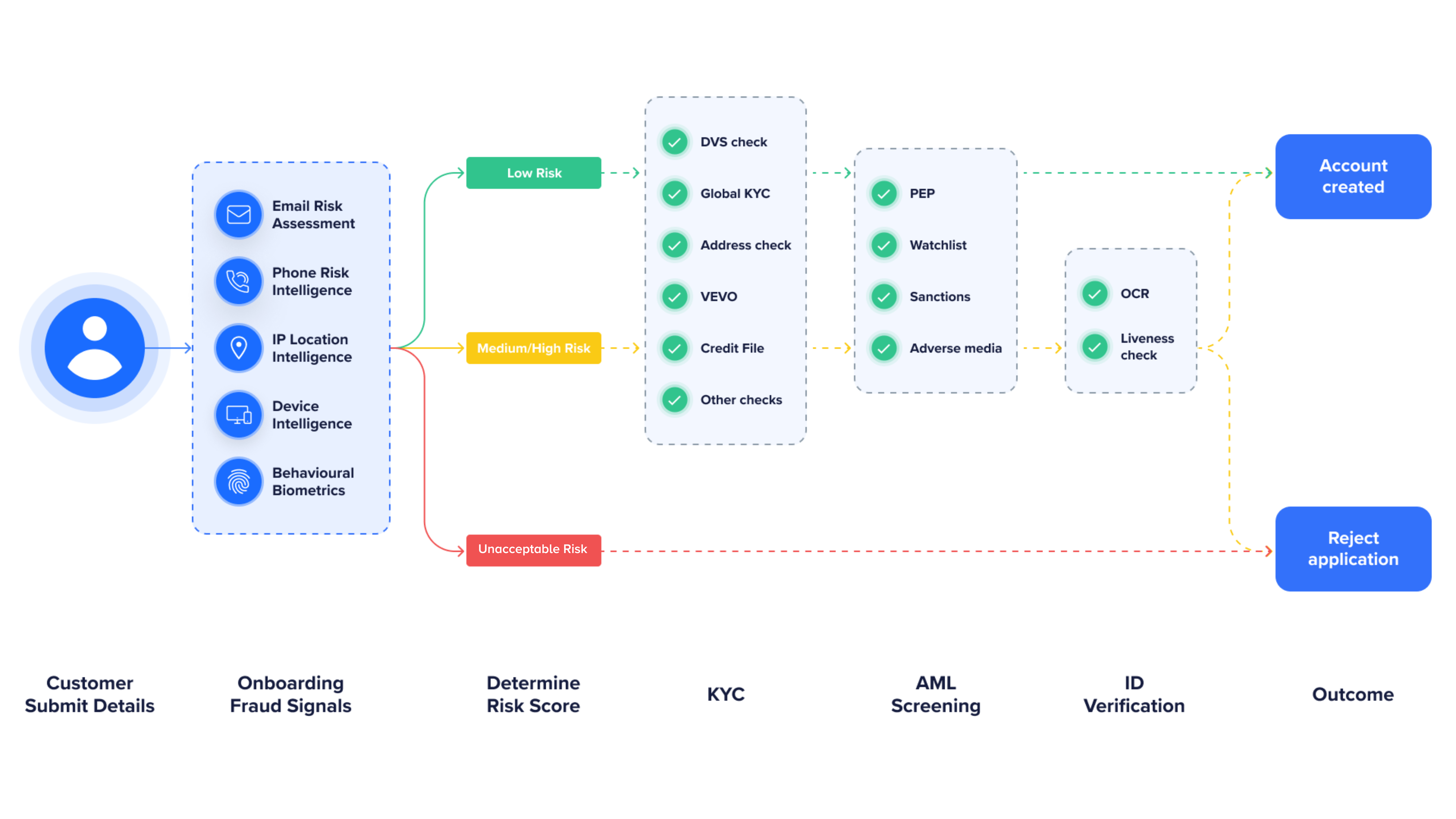
Where platforms diverge is what happens beyond the initial ID check. A modern KYC platform coordinates document verification, PEP and sanctions screening, adverse media monitoring, beneficial ownership identification, and ongoing customer due diligence within a single integration. It’s the system of record for customer trust: it determines how fast you onboard, how accurately you assess risk, and how confidently you front up to an AUSTRAC audit.
Here’s the problem enterprise buyers keep running into. The platform they’re evaluating was built to do one thing well, then bolted on everything else. ID verification from one vendor, sanctions screening from another, KYB from a third, an ongoing monitoring tool that doesn’t talk to any of them. That fragmentation isn’t just annoying. It creates audit gaps, inconsistent risk decisions, and single points of failure in your onboarding flow. And at enterprise volume, those gaps compound fast.
What Actually Matters When You’re Evaluating KYC Vendors
The vendor comparison sites will give you a feature matrix. Here’s what the matrix won’t tell you.
Single-source verification is a liability you can’t afford
If your KYC software verifies against one data source and that source has an outage, a data gap, or a formatting mismatch, your onboarding stops. Or worse: it passes someone it shouldn’t.
The strongest KYC platforms verify against multiple sources in a single API call. Government ID databases (including Australia’s Document Verification Service), credit bureaus, biometric data, device signals. That layered approach catches inconsistencies that single-source checks miss, and it means you’re not dependent on any one provider’s uptime or data quality.
Screening needs to live inside the verification flow
Ask your KYC vendor this: when a customer hits onboarding, does sanctions screening inform the approval decision, or does it run in a separate workflow after the fact? The difference matters more than most AML platform providers will admit.
Under Australia’s reformed AML/CTF Act, the risk-based approach means screening has to directly shape how you onboard a customer, not tick a box afterward. If your screening and your verification are separate products from separate KYC service providers, you’re building risk decisions on fragmented data.
Risk-based onboarding rules that actually flex
A sole trader opening a business account and a complex trust structure with multiple beneficial owners shouldn’t go through the same verification process. Obvious, right? But a surprising number of KYC platforms still run a fixed set of checks regardless of risk level.
Configurable workflow rules let you route low-risk customers through instant verification while escalating high-risk applications for enhanced due diligence. When Lumi, an Australian business lender, moved to risk-based onboarding with configurable workflows, they unlocked $45,000+ in annual operational savings and prevented approximately $400,000 in potential fraud losses within the first 90 days. Blanket manual review to exception-based processing. Completely different cost equation.
If it wasn’t built for Australia, it won’t work here
Many global KYC vendors weren’t designed for the ANZ regulatory environment. DVS integration, AUSTRAC reporting, risk-based AML/CTF program requirements, local data residency expectations: all specific to this market. A platform that performs brilliantly in the UK or Singapore but can’t verify against Australian government databases isn’t fit for purpose here. Full stop.
KYB and beneficial ownership: the half most KYC platform providers ignore
If you’re onboarding business customers, individual identity checks are only half the picture. KYB verification (company registry checks, director screening, UBO identification) is essential for B2B fintechs, lenders, and platforms. And with Australia’s reformed AML/CTF Act expanding beneficial ownership obligations, platforms that treat KYB as an afterthought will struggle to meet requirements at scale.
Ongoing monitoring, not just day-one checks
Customer risk profiles change. Sanctions lists update, adverse media emerges, PEP status shifts. A KYC platform that only checks at onboarding leaves a growing blind spot. You need ongoing monitoring that surfaces changes to your team when they happen, not a snapshot from six months ago that nobody looks at.
Vendor orchestration: the decision that determines everything else
This is the capability that separates KYC software built for 2026 from KYC software built for 2019.
Single-vendor tools create lock-in. Your provider’s data source goes down? Onboarding stops. A better biometric provider enters the market? Switching costs are prohibitive. You expand into a new jurisdiction? You’re stuck with whatever data sources your vendor supports there.
Orchestration platforms sit above individual data sources and verification providers. You plug in the best sources for each market and use case, build fallback logic so a failed check routes automatically to an alternative, and avoid dependency on any single vendor.
BGL Corporate Solutions chose this approach when building identity verification into its compliance software for 10,000+ accounting and financial services firms across four countries. One orchestration integration gave them KYC, KYB, beneficial ownership verification, and DVS access across every jurisdiction, without managing multiple KYC vendors separately. That’s the difference between an architecture that scales and one that creates technical debt with every new market.
KYC Software for Banks vs Fintechs:
Same Obligations, Different Priorities
Banks and fintechs share AML/CTF obligations. How they operationalise KYC looks quite different.
|
Requirement |
Banks and ADIs |
Fintechs and neobanks |
|
Volume profile |
Moderate volume, higher complexity per application |
High volume, speed-sensitive |
|
Integration model |
Core banking system integration, often legacy |
API-first, modern stack |
|
Regulatory scope |
APRA + AUSTRAC obligations |
AUSTRAC obligations |
|
Onboarding priority |
Thoroughness and risk management |
Speed as a competitive advantage |
|
Procurement |
Larger budgets, longer cycles |
Lean teams, self-serve preferred |
Banks need depth: configurable risk rules, integration with existing core systems, complex entity handling. Fintechs need speed: fast API response times, developer-friendly docs, onboarding flows that don’t create drop-off.
The best KYC platforms are built for both, and orchestration architecture is what makes that possible. The same infrastructure powers a 30-second fintech onboarding and a multi-layered bank origination workflow, configured differently. Banks like Westpac run on this model alongside fast-moving fintechs and crypto exchanges.
The Regulatory Shift That’s Forcing KYC Platform Decisions in 2026
Two things are happening in the Australian market right now that directly affect how enterprise buyers should think about KYC software.
Risk-based compliance has replaced the safe harbour
The reformed AML/CTF Act has moved Australia from prescriptive rules to a risk-based model. Organisations now design, implement, and document their own risk-based programs. KYC software that only runs a fixed set of checks won’t satisfy this. You need configurable rules that adapt to different risk levels and customer types, and you need the audit trails that demonstrate your risk-based reasoning to a regulator.
For compliance teams, this is operationally significant. It’s not enough to verify. You have to prove why you verified the way you did, for every customer, at any point a regulator asks.
Tranche 2 is reshaping the competitive landscape
AML/CTF Tranche 2 takes effect on 1 July 2026, bringing approximately 100,000 new entities (accountants, lawyers, real estate agents, trust and company service providers) under AUSTRAC reporting obligations for the first time. The AML/CTF Amendment Act 2024 received Royal Assent on 10 December 2024, with Tranche 2 entities required to enrol with AUSTRAC from 31 March 2026 and comply by 1 July.
Why should enterprise banks and fintechs care about this? Because the flood of new entities entering the regulated space will put pressure on KYC vendor capacity, drive up demand for Australian-specific verification infrastructure like DVS, and reshape competitive dynamics. The organisations that have already built their compliance infrastructure will have a structural advantage over those still evaluating.
DVS remains the benchmark
Any KYC platform operating in Australia should integrate directly with the Document Verification Service, verifying customer identities against primary government sources rather than relying on credit bureau data or document OCR alone. If your platform doesn’t offer DVS integration, it wasn’t built for this market.
How to Evaluate KYC Software: What Good Answers Look Like
When you’re shortlisting KYC platforms, these are the questions that separate serious vendors from the rest. But asking the right questions is only half of it. Here’s what a good answer sounds like versus a bad one.
Does the platform verify against Australian government databases (DVS) directly? You want a straightforward yes, with details on which document types are supported and how DVS results feed into the workflow. “We support document OCR” or “we verify against credit bureau data” aren’t the same thing. Not even close.
Can workflows be configured by risk level, customer type, and jurisdiction? Look for a no-code or low-code workflow builder your compliance team can adjust without filing a dev ticket. If every rule change requires engineering, you won’t keep pace.
Is AML/PEP screening integrated or bolted on? Integrated means the screening result informs the verification decision in real time. Bolted on means screening happens in a separate step, and a customer can be approved before screening completes. You’d be surprised how many KYC AML providers work this way.
KYC and KYB in a single integration? If individual and business verification are separate products (or separate vendors), you’re maintaining two integrations, two data models, two sets of workflows. At enterprise scale, that doesn’t hold.
What happens when a data source goes down? The answer you want: automatic failover. The platform routes to an alternative provider without manual intervention and without the customer noticing. The answer you don’t want: “We notify your team and you switch manually.”
Can you swap verification providers without rebuilding your integration? This is the orchestration test. If adding a new biometric provider means a new integration project, you’re locked in. Orchestration means switching through configuration, not code.
Ongoing monitoring and continuous due diligence? Day-one verification isn’t enough. Ask how alerts are generated, how often watchlists refresh, and how changed risk profiles surface to your team.
Operational across multiple jurisdictions? If you operate across Australia, New Zealand, the UK, or Asia, ask for specifics on data coverage, regulatory support, and existing deployments in each market. Vague answers about “global coverage” aren’t good enough.
Stop Choosing Between Speed, Accuracy, and Compliance
Your KYC software shouldn’t force that trade-off. The right platform delivers all three through an orchestration architecture that connects the best data sources, verification providers, and screening tools in a single integration, with the flexibility to adapt when regulations shift.
We built FrankieOne for exactly this. One API, 350+ global data sources, configurable workflowxs, DVS integration, and the orchestration architecture that banks like Westpac trust alongside fast-moving fintechs and platforms across 195 countries.
Talk to the FrankieOne team and see how FrankieOne works for your use case →
Frequently Asked Questions
What is KYC software?
KYC software automates customer identity verification and risk assessment before onboarding. It replaces manual checks with API-driven workflows that match customer data against government databases, credit bureaus, sanctions lists, and biometric sources. A modern KYC platform also coordinates document verification, PEP screening, adverse media monitoring, and ongoing due diligence.
What features should a KYC platform include?
The features that matter most for enterprise buyers in 2026 are multi-source identity verification (not single-source), integrated AML and PEP screening within the verification flow, risk-based onboarding rules that flex by customer type, KYB and beneficial ownership verification, ongoing monitoring, and vendor orchestration with automatic failover. For Australian organisations, direct DVS integration and AML/CTF risk-based program support are also non-negotiable.
How is KYC software different for banks vs fintechs?
Banks typically need deeper risk management, core banking system integration, and complex entity handling. Fintechs prioritise speed, API-first integration, and low-friction onboarding. The best KYC platforms support both through configurable workflows on an orchestration architecture that flexes to different requirements without separate integrations.
What KYC AML providers should Australian organisations consider?
Australian organisations should evaluate KYC AML providers based on DVS integration (government-grade identity verification), AUSTRAC reporting support, configurable risk-based workflows, KYB and beneficial ownership verification, and multi-jurisdictional coverage. Orchestration platforms that connect multiple data sources through a single API avoid vendor lock-in and provide automatic failover.
What is AML/CTF Tranche 2 and how does it affect the KYC market?
Tranche 2 of Australia’s AML/CTF reform takes effect on 1 July 2026, bringing approximately 100,000 new entities under AUSTRAC reporting obligations. While Tranche 2 primarily affects professional services firms entering regulation for the first time, it’s reshaping the broader KYC market by increasing demand for Australian-specific verification infrastructure and putting pressure on vendor capacity. The AML/CTF Amendment Act 2024 received Royal Assent on 10 December 2024.
What is the DVS and why does it matter for KYC in Australia?
The Document Verification Service (DVS) is an Australian government system that verifies identity documents against primary government sources. KYC platforms that integrate with DVS provide government-grade verification rather than relying on credit bureau data or document OCR alone. For any organisation operating under Australian AML/CTF obligations, DVS integration is the benchmark.
.png)